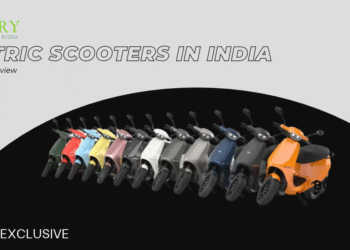


Mumbai November 19, 2026: India’s electric scooter market has gone mainstream in 2026. A record 2,23,847 electric two-wheelers were registered in October 2026, up 48% year on year, and electric now accounts for roughly one in nine two-wheelers sold. The market has also changed hands. Legacy manufacturers TVS, Bajaj and Hero now outsell the start-ups that created the segment, Ather has moved into the sub-₹1 lakh class with the Konarc, and all three Japanese majors (Honda, Suzuki, Yamaha) are now on sale. Buyers today choose from more than 20 serious high-speed models between roughly ₹80,000 and ₹2 lakh. This review covers every major high-speed electric scooter on sale in India as of November 2026: who is selling, the full specifications table, a short verdict on each model, and our picks by buyer type.
How to read the numbers. Prices are ex-showroom and vary by city, state subsidy and festive offers. Ranges are manufacturer-claimed IDC figures; expect 70–80% of the claim in real city riding.
Market snapshot: who is selling
TVS leads the market. In October 2026 it became the first brand to cross 60,000 electric two-wheelers in a month, while Ola fell to fifth. The top four brands sell only scooters, so this ranking is effectively the e-scooter league table.
| Rank | Brand | Key scooters | Oct 2026 units | Change vs Oct 2025 |
| 1 | TVS Motor | iQube, Orbiter | 60,429 | +95% |
| 2 | Bajaj Auto | Chetak | 49,067 | +51% |
| 3 | Ather Energy | Rizta, 450, Konarc | 31,796 | +5% |
| 4 | Hero MotoCorp | Vida VX2, Vida V2 | 29,901 | +81% |
| 5 | Ola Electric | S1 X, S1 Pro, S1 Z | 12,096 | −26% |
Source: Vahan registrations
Hero’s Vida now trails Ather by under 1,900 units, down from a gap of more than 13,700 a year earlier. Honda, Suzuki and Yamaha remain marginal sellers: Suzuki sold 2,261 e-Access units in January–April 2026, against 1,284 Honda Activa e and QC1 units.
Full specifications: every major model
The range spans from ₹80,000 commuters with 2 kWh batteries to ₹1.9 lakh performance scooters claiming over 300 km. Sorted by starting price.
| Model | Ex-showroom price (₹) | Battery (kWh) | Claimed IDC range (km) | Top speed (km/h) | Best for |
| Ola S1 X / S1 X+ (Gen 3) | 79,999 – 1.35 lakh | 2.0 – 5.2 | 108 – 320 | up to 125 | Maximum range per rupee |
| Ola S1 Z | from ~80,000 | up to 5.1 | 179 – 301 | Not yet published | Budget long range, swappable |
| Sokudo Pace | 83,951 | LFP pack | ~115 (real city) | — | Lowest-cost long-life battery |
| Honda QC1 | ~90,000 | 1.5 | 80 | 50 | Short city errands |
| Bajaj Chetak (C2501 / 3001 / 35 Series) | 91,399 – 1.52 lakh | 2.5 – 3.5 | 113 – 155 | 55 – 73 | Build quality, metal body |
| TVS iQube (2.2 to ST 5.3) | ~95,000 – 1.72 lakh | 2.2 – 5.3 | 94 – 212 | 75 – 82 | Families, service reach |
| Hero Vida VX2 | 99,490 – 1.10 lakh (BaaS from 44,990) | 2.2 – 3.4 | 92 – 142 | 70 | Low entry cost, removable battery |
| TVS Orbiter | 99,900 – 1.05 lakh | 3.1 | 158 | 68 | Value commuter |
| Ather Konarc S | 99,999 – 1.45 lakh | 2.1 – 3.5 | 100 – 161 | 70 | Ather tech at mass price |
| Ampere Nexus | 1.20 – 1.30 lakh | ~3.0 | 100 – 136 | 93 | Mid-price all-rounder |
| Honda Activa e | 1.18 – 1.53 lakh | 3.0 (2 × 1.5 swappable) | 102 | 80 | Battery-swap cities only |
| Ather Rizta | 1.15 – 1.84 lakh | 2.9 – 3.7 | 123 – 161 | 80 | Family comfort and software |
| Ola S1 Pro / S1 Pro+ (Gen 3) | 1.25 – 1.90 lakh | 3.0 – 5.3 | 176 – 320 | up to 141 | Range and speed |
| Ather 450 (450S / 450X / Apex) | 1.28 – 1.90 lakh | 2.9 – 3.7 | 122 – 161 | ~90 – 100 | Enthusiast handling |
| Ultraviolette Tesseract | ~1.45 lakh | up to 6.0 | 162 – 261 | 125 | Performance tech, radar and dashcams |
| River Indie | 1.46 lakh | 4.0 | 161 – 163 | 90 | Utility, 43 L storage |
| Yamaha EC-06 | 1.68 lakh | 4.0 | 169 | 79 | Yamaha badge on River platform |
| Simple One (Gen 2) | 1.70 – 2.05 lakh | 5.0 | 212 – 265 | ~105 | Longest fixed-battery range |
| Suzuki e-Access | 1.88 lakh | 3.07 | 95 | 71 | Brand loyalists only |
Figures marked ~ are approximate; check the maker’s site before quoting a final price. Sub-25 km/h low-speed scooters (Komaki, Warivo and others, ₹45,000–55,000) need no registration and are excluded.
Model-by-model reviews
TVS iQube — the market leader
The iQube is India’s best-selling electric scooter because it does everything well and is backed by TVS’s dealer network. Five battery sizes span 2.2 to 5.3 kWh, and the ST 5.3 claims 212 km. Verdict: the safest all-round buy for a family. Watch for: top speed tops out near 82 km/h, and the larger packs push the price above ₹1.7 lakh.
TVS Orbiter — the value champion
The Orbiter puts a 3.1 kWh battery and a claimed 158 km into a scooter priced around ₹1 lakh. Storage is 34 litres and kerb weight is 112 kg. Verdict: the most range for the money from a big brand. Watch for: a hub motor and a 68 km/h ceiling make it a city scooter, not a highway one.
Bajaj Chetak — built like a tank
The Chetak’s metal body and refined ride remain its calling cards. The 2026 line runs from the C2501 (2.5 kWh, 113 km, 55 km/h) through the 3001 (3.0 kWh, 127 km) to the 35 Series with a 3.5 kWh floorboard battery, up to 155 km and a 35-litre boot. Verdict: best build quality in the class. Watch for: the cheaper variants are noticeably slower.
Ather Rizta — the family favourite with the best software
The Rizta made Ather a volume player, accounting for about 76% of its FY2026 dispatches. It has one of the longest seats in the segment, 34 litres of storage, 2.9 or 3.7 kWh batteries and up to 161 km. Ather keeps adding features over the air, such as crowdsourced pothole alerts in July 2026. Verdict: the most polished ownership experience. Watch for: the top Rizta Z costs close to ₹1.8 lakh.
Ather 450 series — for riders who enjoy riding
The 450S, 450X and 450 Apex are the sharpest-handling scooters in India, with quick acceleration and a mature fast-charging network. Verdict: the enthusiast’s choice. Watch for: 22 litres of storage and a firm ride; the Apex is about ₹1.9 lakh.
Ather Konarc — the newest disruptor
Launched on 29 August 2026 on Ather’s new EL platform, the Konarc S starts at ₹99,999 with 2.1, 2.7 or 3.5 kWh IP67 batteries and 100–161 km of claimed range. Park Assist reverse and AutoHold come standard. A 200 km variant and the better-equipped Z line are still on the roadmap. Verdict: Ather quality at petrol-scooter money. Watch for: a 70 km/h top speed, and early sales have been slower than expected.
Hero Vida VX2 — the cheapest way in
The VX2 has a removable battery and an optional battery-as-a-service plan that cuts the upfront price to about ₹45,000, with a monthly fee for the battery. Range is 92–142 km and top speed 70 km/h. Vida is the fastest-growing big brand, up 81% year on year in October. Verdict: best for a low upfront cost. Watch for: owners report a stiff rear suspension.
Ola S1 range — most range and speed per rupee
Ola’s Gen 3 scooters lead on specification: the S1 X+ 5.2 kWh and S1 Pro+ 5.3 kWh use Ola’s own 4680 Bharat cells and claim 320 km, and the S1 Pro+ reaches 141 km/h. The new S1 Z adds swappable batteries from December 2026. Verdict: unbeatable spec sheet. Watch for: Ola’s sales fell 26% year on year in October amid service concerns; check the nearest service centre before buying.
Ultraviolette Tesseract — tech flagship
The Tesseract brings 14-inch wheels, radar-based safety features, dashcams and up to a 6 kWh battery claiming 261 km and 0–60 km/h in 2.9 seconds . Verdict: the most advanced scooter on sale at around ₹1.45 lakh. Watch for: a small, young service network.
River Indie — the SUV of scooters
The Indie offers 43 litres of storage, 14-inch wheels, a 4 kWh battery and 161 km of claimed range at about ₹1.46 lakh. Verdict: the most practical load-carrier. Watch for: a full charge takes about five hours on the standard charger.
Simple One — range on a fixed battery
The Simple One’s 5 kWh pack claims 212–265 km, the longest of any non-Ola scooter. Verdict: for long daily commutes. Watch for: at ₹1.7–2.05 lakh it is expensive, with limited dealers outside the south.
Ampere Nexus — the quiet all-rounder
Greaves’ Nexus offers a 93 km/h top speed and about 100 km of range at ₹1.20–1.30 lakh. Verdict: a sensible mid-price option. Watch for: rivals at the same price now offer more range.
The Japanese trio: Honda, Suzuki, Yamaha
- Honda Activa e (₹1.18–1.53 lakh, 102 km) runs on two swappable packs that need Honda’s swap stations; the QC1 (₹90,000, 80 km, 50 km/h) is a basic city runabout. Honda paused production in August 2025 because of high inventory .
- Suzuki e-Access (₹1.88 lakh, 3.07 kWh, 95 km) is well built but the most expensive scooter here for the least range.
- Yamaha EC-06 (₹1.68 lakh, 4 kWh, 169 km, 79 km/h) is co-developed with River and based on the Indie sold through Yamaha’s Blue Square showrooms.
Verdict: all three trail Indian rivals on value; buy one only for the brand.
Our picks
| If you want… | Buy | Why |
| The safest all-round buy | TVS iQube | Widest service network, five battery sizes |
| The most value under ₹1.1 lakh | TVS Orbiter | 158 km claimed range at about ₹1 lakh |
| Premium tech under ₹1 lakh | Ather Konarc S 100 | Ather software and IP67 battery at ₹99,999 |
| The best family scooter | Ather Rizta | Biggest seat, 34 L storage, best app |
| Build quality | Bajaj Chetak 35 Series | Metal body, 35 L boot, up to 155 km |
| The lowest upfront cost | Hero Vida VX2 (battery subscription) | About ₹45,000 upfront |
| Maximum range | Ola S1 Pro+ 5.3 kWh / S1 X+ 5.2 kWh | 320 km claimed |
| Performance and safety tech | Ultraviolette Tesseract | Radar, dashcams, 125 km/h |
| Carrying capacity | River Indie | 43 L storage, 14-inch wheels |
Before you buy
- Match range to your commute. Take 70% of the claimed IDC range as your real figure, then keep a 30% buffer.
- Check the nearest service centre first. Service quality now separates brands more than specifications do.
- Compare battery warranties. Ather offers 10 years on the Konarc’s battery pack; most rivals offer 3 years or 30,000–50,000 km.
- Get the on-road price. Registration, insurance and state subsidies change the final cost by ₹5,000–15,000.
- Test-ride with a pillion. Hub-motor entry scooters lose noticeable pace with two people on board.