

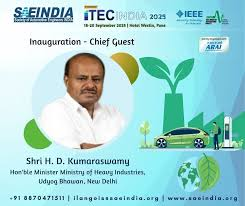
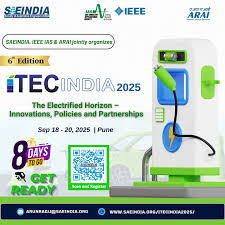
PUNE: 17th September 2025: India’s top electric vehicle makers, policymakers, and technology innovators are all set to gather in Pune on Thursday as iTEC 2025 will kick off from tomorrow, aiming to chart a clear path forward for the country’s electric mobility future.
The three-day conference brings over 100 expert speakers and panels to the stage, tackling critical challenges such as establishing nationwide charging highways, evolving battery recycling infrastructure, and harnessing AI-driven engineering to accelerate EV adoption.

Launched a decade ago when electric vehicles were little more than a policy experiment, the iTEC forum is being co-hosted by ARAI and SAEINDIA, has evolved into a bellwether for India’s ambitions to transform transportation.
This year’s theme, “The Electrified Horizon, Innovations, Policies and Partnerships,” places the spotlight on both familiar hurdles and future breakthroughs.
More than 100 technical papers, expert keynotes, and panels promise a no-holds-barred examination of issues shaping the EV sector: engineered highways for rapid charging, the scramble to solve end-of-life battery recycling, and India’s struggle to localize technologies as global supply chains remain under strain.
Policy clarity is on the agenda, with Heavy Industries Minister H. D. Kumaraswamy set to outline the government’s priorities. Industry leaders, including Ashish Mishra of Ather Energy and Senthur Pandian of Mahindra Electric Mobility, will detail the next wave of technology bets.
At the same time, Dr. Ramnik Singh of Gamma Technologies is expected to highlight competitive product roadmaps. Global voices, among them MathWorks’ Sunil Motwani and Rashmi Rao, are also geared to make the case for simulation, AI, and model-based engineering as the linchpins of future vehicle design.
 “iTEC India 2025 is more than a conference—it is a catalyst for shaping the future of transportation electrification. It creates a unique ecosystem where visionaries and businesses converge to drive transformation,” said Dr. Atul Thakare, Deputy General Manager at ARAI and conference co-organizer.
This year’s sessions push the dialogue beyond technology, turning the lens on life-cycle sustainability, the circular economy, and thorny questions over how India will manage mounting battery waste as EV sales accelerate., he informed The larger electrification puzzle of intercity corridors and highway charging—seen by many as the trigger for mass-market adoption, will also command outsized attention, senior ARAI officials informed EV Story
 Yet as India’s ambitions collide with hard realities, the debate over localizing semiconductors and embedded electronics looms large. The conference’s shift from hardware-first focus to software and data-driven innovation is as much a story of necessity as it is of opportunity.
A decade since iTEC’s beginnings, the stakes have never been higher. With net-zero deadlines on the horizon, expanded production-linked incentives, and double-digit EV growth, the conversations now unfolding in Pune are set to define the next, and arguably most consequential, chapter in India’s mobility revolution.