

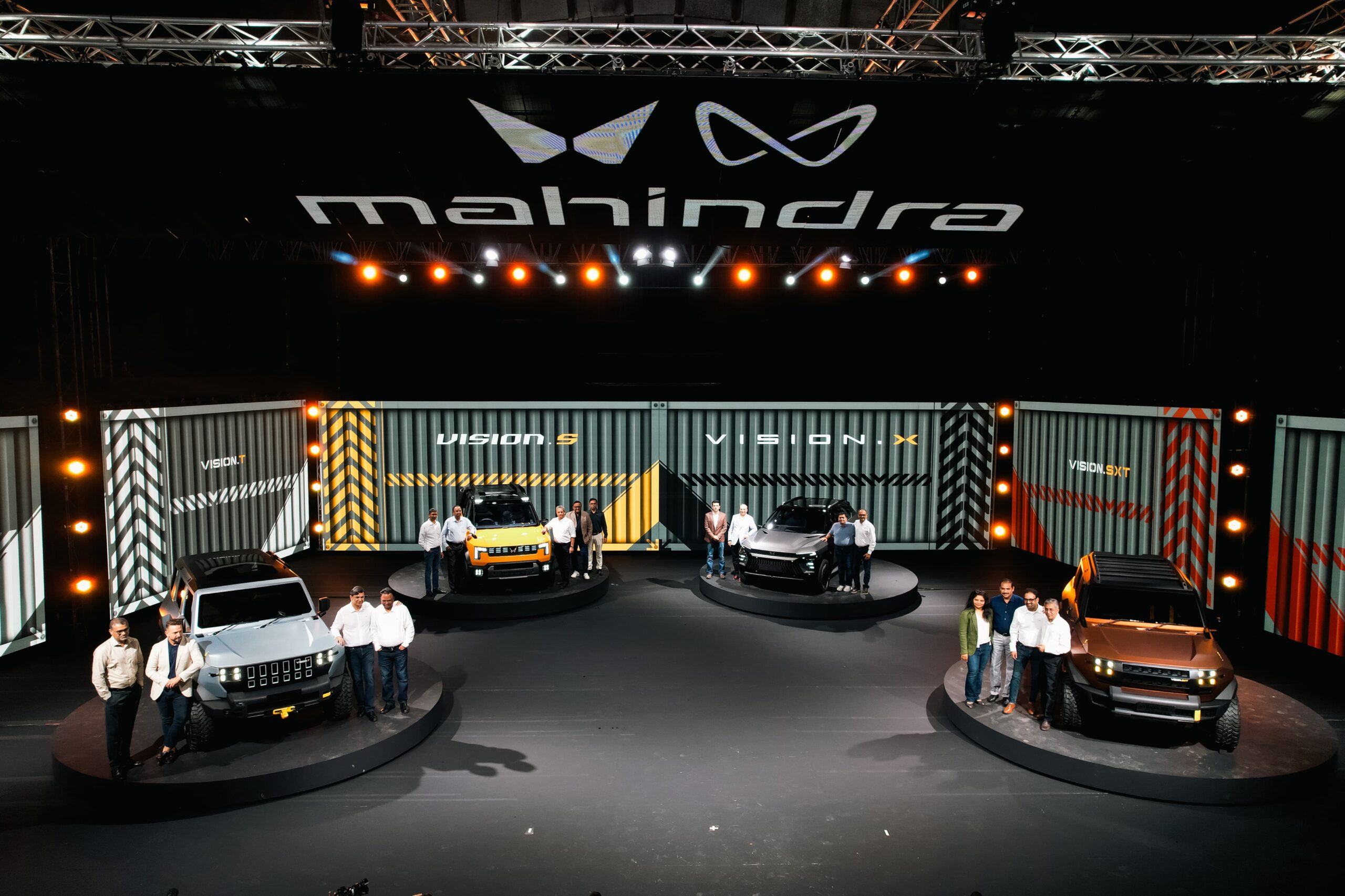
MUMBAI, 16th August 2025: Mahindra’s Vision SXT, which introduced four futuristic SUV concepts and was unveiled on Independence Day, may appear to be auto-show showpieces rather than mass-market vehicles.
But behind the sleek forms lies something more consequential: NU_IQ, a modular, multi-energy platform through which Mahindra is making its boldest attempt yet to win India’s most hotly contested battleground—the compact and mid-size SUV market.
 For decades, Mahindra & Mahindra has thrived on rugged, body-on-frame vehicles like the Bolero and Scorpio, staples in rural and semi-urban India. More recently, it has scored with lifestyle and premium models such as the Thar, XUV700, and its BE range of electric SUVs.
Yet the company has consistently fallen short in the compact and mid-size segments, long dominated by Maruti Suzuki’s Brezza, Hyundai’s Venue and Creta, Kia’s Seltos, and Tata’s Nexon.
These models sit at the sweet spot for India’s aspirational urban middle class, offering the balance of affordability, features, and brand value.
NU_IQ signals Mahindra’s determination to change that. “NU_IQ is a strategic blueprint for the future of Mahindra SUVs worldwide,” said R. Velusamy, president-designate of Mahindra’s automotive business. “It enables us to innovate across multiple powertrains while remaining true to our SUV DNA.”
A Market Mahindra Can’t Afford to Miss
Compact and mid-size SUVs, priced between ₹10–20 lakh, account for more than half of India’s passenger vehicle sales. They represent the first upgrade for salaried professionals and families seeking boot space, fuel economy, and premium features in one package. Mahindra’s previous attempts, the KUV100 and TUV300, missed the mark.
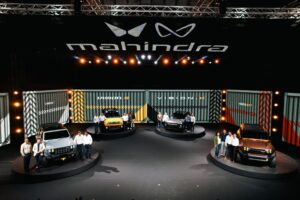
NU_IQ aims to fix this by offering flexibility that no prior Mahindra platform has achieved. Built to handle petrol, diesel, hybrid, and fully electric drivetrains, NU_IQ supports both front- and all-wheel drive as well as right- and left-hand drive formats. That allows Mahindra to tailor vehicles not only for Indian buyers but also for exports.
“NU_IQ combines innovation, global design, and advanced technology to disrupt untapped segments in India and beyond,” said Nalinikanth Gollagunta, CEO of Mahindra’s automotive division. “The four concepts presented here signify a new era of no-compromise mobility.”
From Concept Cars to Production
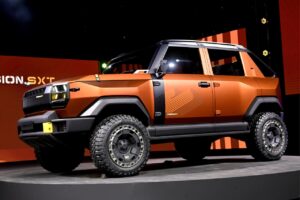
The four concepts—Vision.S, Vision.T, Vision.SXT and Vision. X—marks the next step in Mahindra’s “Heartcore” design philosophy. They were created in design studios in Mumbai and Banbury, United Kingdom, and feature the company’s new “Opposites Attract” theme, which combines ruggedness and sophistication.
Design head Pratap Bose says the aim is to spark an emotional bond while offering futuristic practicality. Flat-floor layouts maximise interior space, while class-leading boot volumes and sci-fi-like technology are powered by Mahindra’s new integrated software stack, NU_UX.
Production versions are scheduled for 2027, with Mahindra’s Chakan plant near Pune serving as the launch site. To prepare, the automaker is adding 240,000 units of annual capacity, bringing Chakan’s total output to approximately 760,000 units. A greenfield facility is also under consideration for future expansion.
The global playbook
Though India remains the top priority, NU_IQ supports Mahindra’s global ambitions. The company is taking a “saturation-first” approach, establishing brand presence, dealer networks, and after-sales service in one market before expanding into the next.
South Africa was the first testbed, followed by Australia and New Zealand. Mahindra now plans to expand into the United Kingdom, as well as select regions in Europe, the Middle East, Africa, and Latin America. The company believes its SUVs can fill the “white space” between high-end premium brands and stripped-down entry-level models.
Numbers Back the Timing
Mahindra intends to enter the next phase with momentum. The maker of the Thar and XUV700 is now India’s largest SUV revenue share and second in volume. In the first quarter of FY26, it reported record SUV sales of 152,100 units. However, maintaining that trajectory necessitates breaking into the high-volume compact and mid-size categories, where competitors dominate.
For Mahindra, NU_IQ is more than just a technological shift; it’s a strategic bet on India’s growing middle class, whose spending power and expectations are increasingly shaping the market.
Playing to the middle
Historically, Mahindra’s lineup focused on rugged and premium models, leaving the ₹10-20 lakh SUV range to competitors. NU_IQ aims to close this gap.
The platform will offer both sub-4-meter SUVs to compete with the Brezza, Venue, Nexon, and Sonet, as well as mid-size SUVs to compete with the Creta, Seltos, Grand Vitara, and Toyota Hyryder. Together, these categories account for more than 60% of Indian SUV sales.
“NU_IQ is about democratising premiumness,” stated Mahindra’s Executive Director, Rajesh Jejurikar. The goal is to offer the fit, finish, safety, and technology of larger models at prices affordable to upwardly mobile buyers.
Competitors on alert
Rivals aren’t standing still. Hyundai and Kia are refreshing their core models, Tata Motors is doubling down on EV investments, and Maruti Suzuki is leveraging its unrivalled sales network. Mahindra’s challenge is to provide differentiation without pricing itself out of the competition.
Sceptics point to India’s extensive history of failed SUV experiments, including Mahindra’s own. However, if NU_IQ delivers on its promise of spacious interiors, multiple powertrain options, global-grade safety, and advanced digital technology, it could be Mahindra’s most transformative move since the Scorpio two decades ago.
A defining bet.
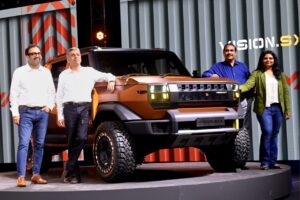
For the time being, the Vision concepts serve as aspirational showpieces. However, they reflect a future in which Mahindra is no longer content to play on the periphery of India’s urban SUV market. With NU_IQ, the company is putting itself right where the competition and the customer is.
If successful, NU_IQ will not only increase Mahindra’s SUV market share. It has the potential to redraw the battle lines in India’s most important vehicle category, where aspiration and affordability collide.