

NEW DELHI, 15th September, 2025 – The Federation of Automobile Dealers Associations (FADA), the apex body of automobile retail in India, announced the results of its annual Dealer Satisfaction Study (DSS) 2025 during the 7th Auto Retail Conclave held on September 10. Conducted in partnership with Singapore-based consulting firm PremonAsia, the study reflects the evolving dynamics between automobile dealers and original equipment manufacturers across vehicle categories and geographies.
Now in its fifth edition, the DSS 2025 study gathered responses from over 1,800 dealer principals representing nearly 5,000 outlets nationwide.
For the first time, the survey was conducted in nine regional languages, ensuring deep and inclusive participation from the dealer community across India. Using a combination of derived importance and satisfaction ratings, the study indexed responses on a 1,000-point scale to rank performance across segments.
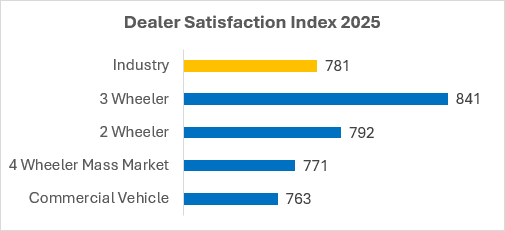
JSW MG Motor retained its top position in the four-wheeler mass market category with an industry-leading score of 868. In the two-wheeler category, Royal Enfield led with 852 points, followed closely by Hero MotoCorp. Ashok Leyland maintained its leadership in the commercial vehicle segment with 786 points, while Tata Motors showed notable year-on-year gains.
Atul Auto marked a strong comeback in the three-wheeler category with an impressive score of 924, and Volvo Cars topped the luxury four-wheeler category with 884 points.
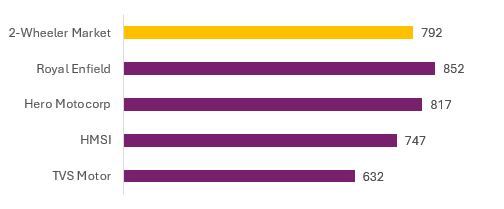
Noteworthy movements in this year’s rankings include Royal Enfield and Hero MotoCorp improving by over 140 points each—the highest gains across all segments. Renault India saw a 90-point jump in the four-wheeler mass segment, moving closer to mid-table rankings. Among commercial vehicle players, Tata Motors was the only OEM to improve over the previous year.
The industry’s average dealer satisfaction score improved to 781, up by 13 points from last year. While ‘Product’ continues to score the highest across all categories, reflecting strong dealer confidence in vehicle quality and reliability, ‘After-Sales Service’ emerged as the most important factor shaping dealer sentiment, followed by ‘Business Viability and Policy’. Despite the gains, dealers continue to voice concerns over key issues such as buyback policies, margins, training cost-sharing, and the long-term viability of dealerships.
Commenting on the study, C S Vigneshwar, President, FADA, said, “The Dealer Satisfaction Study provides a true mirror to the evolving dealer–OEM relationship. This year, the message from the ground is clear.
While our industry continues to win on product quality and reliability, structural issues like buyback policies, training costs, and dealership viability cannot be overlooked.
Dealers are strongly voicing the need for fairer margins, greater policy flexibility, and more meaningful engagement in OEM decision-making at national, regional, and zonal levels.”
Rahul Sharma, Director and Chief Operating Officer, PremonAsia, added, “While product remains the strongest driver of dealer satisfaction, after-sales and viability factors continue to dominate dealer mind space. Our analysis shows that close to two-thirds of dealer sentiment is shaped by these areas. Addressing concerns such as inventory costs, buyback policies and training arrangements can make a meaningful difference to dealer confidence and long-term partnerships.”
Segment-wise insights further reveal that two-wheeler dealers remain more satisfied this year, citing strong product portfolios, frequent model updates, effective customer-facing training, and transparency in warranty claim processing. However, they continue to struggle with policies on unsold inventory, training cost-sharing, and OEM openness to dealer feedback.
Four-wheeler mass market dealers appreciate product dependability, training programs, and extended warranty policies but face operational challenges. Issues include unsold inventory write-offs, training cost burdens, and lack of clarity on inventory carrying norms and overall dealership profitability models.
In the commercial vehicle category, dealers praised product reliability, range, supply consistency, and order fulfilment. Yet, long-standing concerns persist around dealership viability, training expenses, vehicle-off-road parts margins, and profit sustainability.
With India emerging as a hub for electric vehicles and clean mobility, FADA’s DSS 2025 underscores that while product innovation is strong, dealer satisfaction hinges on deeper, more equitable partnerships between OEMs and retail partners. Addressing viability issues is essential to ensuring the resilience of India’s fast-evolving auto ecosystem.