

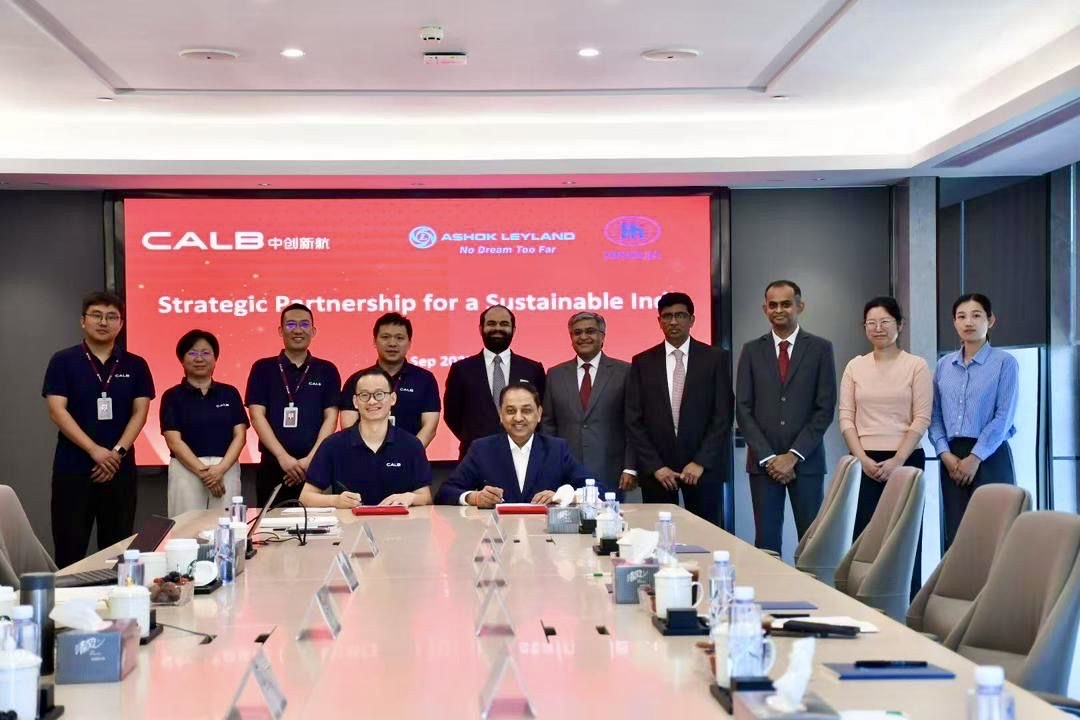
NEW DELHI, 1st September 2025: Ashok Leyland, the Hinduja Group’s flagship and a leading commercial vehicle maker in India, announced plans to invest over ₹5,000 crore in battery development and production over the next seven to ten years. The move aims to strengthen the company’s position in the fast-evolving electric vehicle (EV) market by localising critical battery manufacturing.
The partnership with China’s CALB Group will not only support Ashok Leyland’s EV unit, Switch Mobility, but also target the broader automotive and energy storage sectors. Until now, Ashok Leyland relied heavily on external suppliers for batteries, the most costly EV component. This strategy shift seeks to reduce costs, enhance supply security, and create new revenue streams through sales beyond its own vehicles.
Ashok Leyland’s announcement invites direct comparison to its main rival, Tata Motors, which has gained a head start in the commercial EV space through vertical integration. Tata’s group companies have built large-scale battery manufacturing capacity and supply critical components across its vehicle range. That ecosystem has enabled Tata Motors to control costs, technology, and supply chains, helping it scale rapidly in electric buses and commercial EVs.
In contrast, Ashok Leyland aims to accelerate market entry by leveraging CALB’s established battery technology while localising production in India. The company plans to launch a Global Centre of Excellence focused on battery innovation, encompassing material research, recycling, and advanced manufacturing processes. While initially prioritising automotive uses, the business will gradually expand into grid and renewable energy storage, tapping India’s growing demand given increased solar and wind capacity.
The stakes are high. Commercial vehicle electrification has been slow, limited mostly to government bus tenders; electric trucks face pricing challenges. Local battery production could narrow cost gaps and spur adoption. Analysts caution that Tata’s in-house approach offers greater control, whereas Ashok Leyland’s reliance on a Chinese partner brings its own risks around technology transfer and regulatory scrutiny.
“Battery strategy will decide the
winner in India’s commercial EV sector,” said a Mumbai-based auto analyst. “Tata has nurtured synergies within its group. Ashok Leyland is betting on speed by partnering with an established global player. Both paths carry risk.”
Ashok Leyland’s investment signals a shift in the commercial vehicle arms race, where future success may depend less on engines or chassis and more on controlling the battery chemistry that powers the vehicles.