

NEW DELHI. 12th September 2025: India’s auto component sector took center stage in New Delhi as the ACMA annual convention commenced with an important discussion on the future of supply chains, critical materials, and policy support. The focus was on rare earths, tariff challenges, and the ambition of Indian firms to achieve global leadership.
Incentives for Rare Earth Magnets to Enhance Resilience
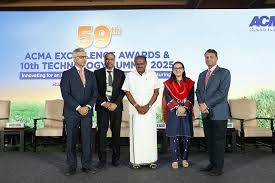 Union Heavy Industries Minister H.D. Kumaraswamy announced new fiscal incentives to boost domestic production of rare earth magnets. This initiative aims to reduce dependence on China’s dominant supply and address vulnerabilities in the electric vehicle ecosystem. “Recognizing that rare earth magnets are essential for EV motors and are currently dominated by Chinese supply, we are preparing fiscal incentives to encourage domestic production,” said Kumaraswamy, who promised proposals for cabinet review if support exceeds ₹1,000 crore.
Rare earths, such as neodymium-iron-boron (NdFeB), are vital for traction motors and advanced electronics, with China producing 60% of global rare earths and refining nearly 90%. Kumaraswamy argued that targeted subsidies would help close cost gaps and attract investments in domestic processing, ensuring supply continuity amid “rising global restrictions.”
Industry Leaders Chart Path to Global Roles
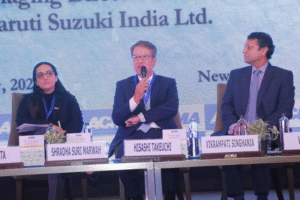 Industry leaders depicted India’s supply chain journey as a critical turning point. Hisashi Takeuchi, CEO of Maruti Suzuki India, highlighted the sector’s potential: “If we combine strategic intent with India’s unique advantages of domestic demand, talent, and policy support, the growth possibilities are limitless.” He emphasized that Indian firms must transition from basic manufacturing to achieving world-class leadership, noting both threats (like U.S. tariffs) and opportunities (including government support and the Make in India initiative).
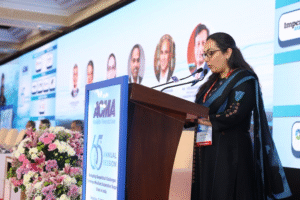 ACMA President Shradha Suri Marwah expressed cautious optimism, pointing out significant challenges from tariffs and raw material shortages. “Tariffs have affected us. We are hopeful that solutions will emerge. We have experienced issues with rare-earth magnets, and there’s still no clarity on that front,” she stated, discussing industry efforts to explore value engineering and capitalize on demand boosts from GST rationalization and festive bookings.
 Vinnie Mehta, ACMA’s Director General, provided data on the impact of tariffs: $6.6 billion in exports to the U.S., with half facing 25% tariffs and the rest up to 50%—a “significant impact” for Indian suppliers targeting North America.
Forecasting a $100 Billion Export Opportunity
A joint report from ACMA and McKinsey delivered an optimistic outlook, projecting that India’s auto component exports could rise to $70–100 billion by FY2030, up from today’s $23 billion. Key drivers of this growth include cost-competitive manufacturing, dual technology capabilities in internal combustion engines (ICE) and electric vehicles (EVs), and market opportunities stemming from shrinking global ICE supply chains. As developed markets readjust, Indian firms are well-positioned to capture the increasing demand for traditional technologies as well as EV technologies, batteries, semiconductors, and connected car systems, although success depends on bridging competitive gaps and meeting global standards.
Outlook: Building Resilience for a New Era
The ACMA 2025 convention highlighted India’s efforts to secure critical resources, strengthen supply chain resilience, and convert policy ambitions into substantial export growth. “India will not only be Atmanirbhar (self-reliant); it will also be the world’s trusted partner in the automotive supply chain,” stated Takeuchi, as leaders considered how to transform rare earths into sources of resilience and opportunities into global reach.