

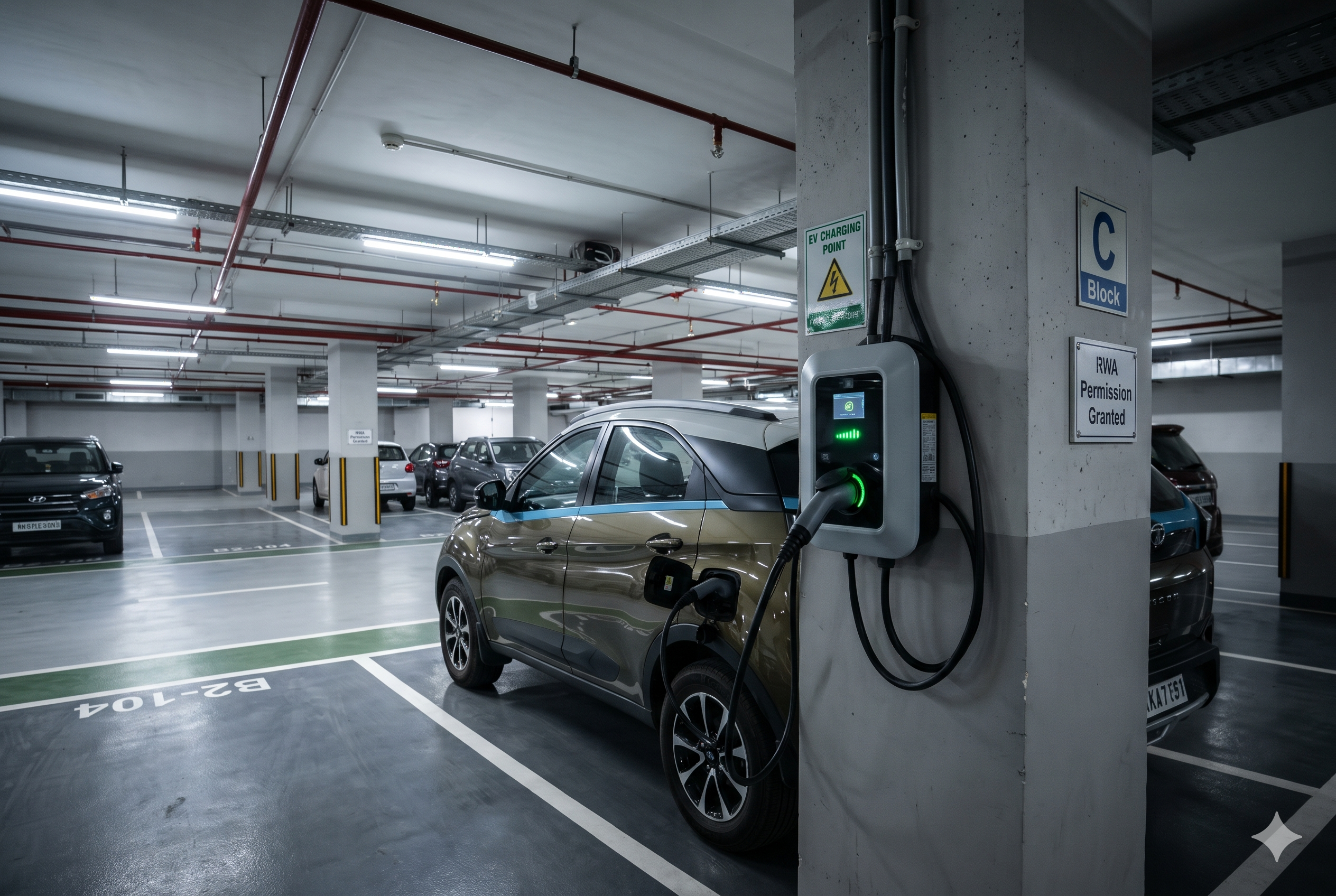
Hyderabad , November 26, 2026: Waking up to a full battery every morning is the single biggest advantage of owning an electric vehicle. In India, home charging costs roughly ₹1 to ₹2 per kilometre on domestic tariffs—compared to ₹3–₹4 per km at public DC fast chargers and ₹6.80+ per km for a petrol car. Over a five-year ownership cycle, shifting to home charging comfortably saves over ₹2 lakh compared to an equivalent petrol vehicle.
Yet for most prospective EV buyers in Mumbai, Delhi, Bengaluru, Chennai, and Hyderabad, the real friction isn’t the car—it’s navigating apartment Resident Welfare Associations (RWAs), estimating turnkey installation costs, and upgrading sanctioned electricity loads with local DISCOMs.
Here is the complete 2026 breakdown of home EV charger installation costs, city-by-city load upgrade workflows, and how fast EV adoption is accelerating across India’s five largest metro markets.
Home EV Charger Installation Cost Breakdown (2026)
What you pay depends on whether you stick to the portable charger supplied with your vehicle or install a dedicated 3.3 kW / 7.4 kW AC wallbox.
| Setup Component | Estimated Cost (INR) | Key Cost Drivers |
| Basic Portable Setup (15A/16A Socket) | ₹3,000 – ₹8,000 | Dedicated wiring run, industrial socket, and earthing check. |
| Wallbox Hardware (3.3 kW – 7.4 kW) | ₹40,000 – ₹1,20,000 (Turnkey) | Includes charger, cabling, switchgear, and labour; apartment turnkey packages typically start around ₹60,000. |
| Cabling, Switchgear & Earthing | ₹8,000 – ₹25,000 | 6 mm² copper cable (for 7.2/7.4 kW), 30 mA Type A RCBO, Surge Protection Device (SPD), and cable run length from meter room to parking bay. |
| Dedicated Chemical Earthing Pit | ₹8,500 – ₹12,000 | Required if existing building earthing fails safety testing. |
| DISCOM Load Enhancement / EV Meter | ₹3,000 – ₹20,000+ | Varies by state, kW increase, security deposit, and whether a 1-phase to 3-phase conversion is required. |
The RWA Rule You Should Know
Under the Ministry of Power’s EV Charging Infrastructure Guidelines (2024), residents have the right to install private EV charging points in their allotted apartment parking spaces. RWAs cannot arbitrarily refuse a compliant installation if the resident bears the cost, uses a licensed electrician, and submits the required safety documentation. Furthermore, new apartment buildings with 20+ units approved after 2022 in states like Delhi, Maharashtra, and Karnataka are mandated to keep 20% of parking bays EV-ready.
The Electricity Load Upgrade Process: Step-by-Step
A 3.3 kW charger can often run on a standard 5 kW domestic connection if heavy appliances aren’t running simultaneously. However, a 7.2 kW or 7.4 kW wallbox draws 32 amps continuously for hours, almost always requiring a sanctioned load upgrade or a three-phase connection.
- Check Current Sanctioned Load: Review your latest electricity bill for your “Sanctioned Load” or “Contract Demand” (in kW).
- Calculate Peak Demand: Add your charger’s rated draw (e.g., 7.4 kW) to appliances that run overnight (ACs, inverters, geysers).
- Conduct a Licensed Site Audit: Hire a government-licensed electrical contractor to inspect your distribution board, measure cable run distance (voltage drop must stay under 3% per CEA guidelines), and issue a safety test report (such as Form ‘A’ in Maharashtra).
- Apply to Your Local DISCOM: Submit an online load enhancement or separate EV meter application with ID proof, ownership/occupancy documents, latest paid bill, and society NOC (if upgrading main service cables).
- Feasibility Check & Demand Note: The DISCOM verifies transformer capacity and issues a demand note for Service Line Charges (SLC) and refundable Security Deposit.
- Energisation & Commissioning: Once paid, the DISCOM updates the sanctioned load or installs the new meter, after which your electrician installs the dedicated circuit, RCBO, SPD, and wallbox.
City-by-City DISCOM, Tariff & Load Upgrade Snapshot
While the technical safety standards (IS 17017 / IEC 61851) are uniform across India, utility workflows and residential tariffs vary sharply across the five metros:
| City | Primary DISCOM(s) | Avg. Home Tariff (2026) | Load Upgrade / Separate EV Meter Notes |
| Mumbai | Adani Electricity, Tata Power, BEST, MSEDCL | ~₹8.50/kWh (Domestic); ~₹4.00–₹4.50/kWh overnight with ToD rebate | Online portal submission + PWD Form ‘A’ test report. 1-phase increase takes 7–21 days (₹1,000–₹3,000 deposit); 1-phase to 3-phase takes 21–45 days (₹8,000–₹20,000). |
| Delhi | BSES Rajdhani, BSES Yamuna, Tata Power-DDL | ~₹5.50/kWh (Domestic); ₹4.50/kWh dedicated LT EV tariff | Fast-track online applications via DISCOM portals; dedicated EV meters offer one of India’s lowest single-part tariffs. |
| Bengaluru | BESCOM | ~₹7.20/kWh | Applicants must coordinate with their local BESCOM subdivision for separate residential EV meters and technical feasibility checks alongside society approval. |
| Chennai | TANGEDCO / TNPDCL | ~₹5.80/kWh | Load enhancement and 3-phase conversions are processed through the state utility portal with mandatory licensed contractor wiring certification. |
| Hyderabad | TGSPDCL | ~₹6–₹9/kWh (Slab-dependent) | Apply via the TGSPDCL online service connection portal with OTP verification and property docs; confirm LT-IX EV charging category eligibility before submitting. |
EV Adoption & Penetration Across India’s Top 5 Markets (FY 2025–26)
Home charging demand is being propelled by record electric four-wheeler (e-4W) adoption. Nationally, 2,19,484 electric cars were registered in FY 2025–26 out of 48.39 lakh passenger vehicles, pushing pan-India e-4W penetration to 4.5%.However, the five metro states are outpacing the national average by a wide margin:
- Hyderabad (Telangana) — The Penetration Leader: Telangana recorded the highest electric car penetration in India at 11.6% (19,810 e-4Ws sold up to Feb 2026), driven overwhelmingly by Hyderabad’s IT corridor and luxury/mid-size EV demand.
- Delhi — Strong Policy-Driven Share: The national capital posted an 8.4% electric car penetration with 16,986 e-4W registrations in FY 2025–26, supported by low EV tariffs and dense residential charging mandates.
- Mumbai (Maharashtra) — The Volume Powerhouse: Maharashtra led the country in sheer sales volume with 34,066 electric cars—accounting for 15.5% of all e-4Ws sold in India, anchored by Mumbai and Pune.
- Bengaluru (Karnataka) — The Tech-Hub Runner-Up: Karnataka captured 11% of India’s total electric car sales with 24,201 units registered in FY 2025–26, with Bengaluru driving the bulk of residential wallbox installations.
- Chennai (Tamil Nadu) — Steady Industrial & Urban Growth: Backed by a strong EV manufacturing base and competitive domestic tariffs (~₹5.80/kWh), Chennai continues to see steady residential EV adoption across both two-wheelers and passenger cars.
Across these markets, Tata Motors retained the top spot in FY 2025–26 with a 38.9% market share (85,367 units), followed by JSW MG Motor at 26.7% (58,661 units) and Mahindra Electric at 21.6% (47,316 units) following a massive 434% year-on-year surge.
Looking Ahead
As electric car penetration crosses double digits in markets like Hyderabad and scales rapidly in Mumbai, Delhi, and Bengaluru, home charging is transitioning from a niche perk to standard residential infrastructure. For homeowners and RWAs alike, auditing sanctioned loads early and opting for dedicated EV meters with Time-of-Day (ToD) rebates is the fastest way to lock in the lowest possible running costs.