

New Delhi-Mumbai, September 4, 2025: India’s auto industry is rallying behind Finance Minister Nirmala Sitharaman’s GST overhaul, a rare moment of agreement among manufacturers, policy advocates, analysts, and trade associations who see the tax reform as a catalyst for mass mobility and a tailwind for the aftermarket.
FICCI, the industry’s lead federation, called the reforms “landmark”, crediting the government for a simplified two-tier structure “that brings transparency, predictability, and stability to India’s tax system, directly benefiting households, MSMEs, and critical sectors such as automobiles” by reducing consumer costs and spurring manufacturing.

Yet, as Randheer Singh, former NITI Aayog director and founder of Forsee Advisors, cautions, the reform also nudges EVs closer to ICE on upfront costs and will ultimately be judged on execution.
Calling the move a “pragmatic reset”, Singh said the uniformisation and cuts can “ease supply-chain frictions, improve working capital, and support Make-in-India manufacturing”, especially when read with the ₹1,500 crore battery-recycling incentive announced a day earlier. But, he added, “keeping charging and battery-swapping services at 18% while cutting small ICE vehicles to 18% narrows EVs’ upfront price advantage. A calibrated review that treats energy for EVs as ‘fuel’ would strengthen adoption without undermining revenue. Implementation discipline, clear notifications, and swift refunds will be critical.”
On the ground, the consumer math is immediate. Entry-level hatchbacks, compact sedans, and subcompact SUVs (<1,200cc petrol / <1,500cc diesel) are set to get cheaper by ~8.5%; large sedans, compact SUVs, and mid-MPVs (<1,500cc) by ~3.5%; and premium SUVs/MPVs (>1,500cc) by ~6.7%. Two-wheelers drop ~7.8% (except >350cc, up ~6.9%). Tractors ~6.3%; three-wheelers, LCVs, MHCVs, and buses by ~7.8%.

Analysts expect a measured but broad-based lift. Hemal Thakkar, Director at CRISIL Intelligence, projects low single-digit growth for passenger vehicles in FY26, higher single-digit growth for two-wheelers, 4–7% for tractors, and flattish to marginally positive growth for commercial vehicles. “A key structural change: all auto components are now under 18% GST, trimming prices of items earlier at 28% by roughly ~7.8% and strengthening the organised aftermarket,” he said
That filters straight to showrooms,’  said Jitin Makkar, Senior VP & Group Head, Corporate Sector Ratings, ICRA:“Lower tax incidence directly translates into reduced on-road prices, making vehicles more affordable—especially in price-sensitive entry and mid segments. Expect a revival in footfalls, faster retail sales, inventory clearance, and positive spillovers for components and financing.”
For suppliers, this is a long-fought win.
Shradha Suri Marwah, President, ACMA, said the 18% uniform “will curb the grey market, encourage quality-compliant parts, ease compliance, and support MSMEs—strengthening the global competitiveness of India’s USD 80.2 billion component industry.”  She also welcomed faster export refund claims via ICEGATE, easing liquidity for smaller exporters.
Automakers’ apex body SIAM lauded the continued 5% GST on EVs. “This will help sustain the momentum towards sustainable mobility,” said President Shailesh Chandra, adding that timely mechanisms for compensation cess utilisation on unsold vehicles would smooth the transition.
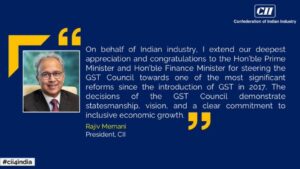
Retailers see a demand kicker. The 56th GST Council meeting is a “watershed moment,” said FADA President C.S. Vigneshwar.

“The reforms simplify the tax structure, lower rates for mass mobility, and bring consensus across states—boosting affordability, spurring demand, and making mobility more inclusive.”
Some spillovers affect the entire economy. The GST on multimodal logistics has been reduced from 12% to 5%, and third-party insurance on goods carriages has been reduced to 5%, according to CRISIL. This relief will lower the operating costs of exporters and transporters, improving their margins, particularly for smaller players.
The emerging consensus: GST rationalisation serves as both a demand stimulus and a formalisation nudge. However, as Singh emphasises, two factors will determine durability: how quickly notifications and refunds are routed through the system, and whether EV-related services are realigned to maintain a clear overall cost advantage.
“Get those right,” he said, “and this reset can speed up domestic value addition, circularity, and investor confidence.”