

HANSALPUR, India (Aug 26) – Suzuki Motor Corp., a Japanese automaker, has started producing and exporting its first electric vehicle, the e-Vitara SUV, from its Gujarat plant, putting India at the centre of its global electric vehicle strategy.
Suzuki’s most definitive entry into the battery-electric segment follows years of caution. It comes as its Indian subsidiary, Maruti Suzuki, faces increased competition from Hyundai, Tata Motors, and Mahindra in India’s rapidly evolving EV market.
“We chose this facility to build our first battery EV and position it as a global production hub,” Suzuki president Toshihiro Suzuki said at the launch. “The e-Vitara will be exported to over 100 countries, including those in Europe and Japan.”
Exports Precede Local Launch
Maruti Suzuki intends to export 50,000 to 100,000 units per year, with the first shipment leaving Pipavav port for major European markets such as the United Kingdom, Germany, France, and Norway. The launch date in India, the world’s third-largest car market, has yet to be announced. Executives cited high battery costs and Indian consumers’ price sensitivity as reasons for their decision.
Unlike most global automakers, which launch EVs domestically before exporting them, Suzuki prioritises international demand to increase production and lower costs.
Battery Localization Moves Forward
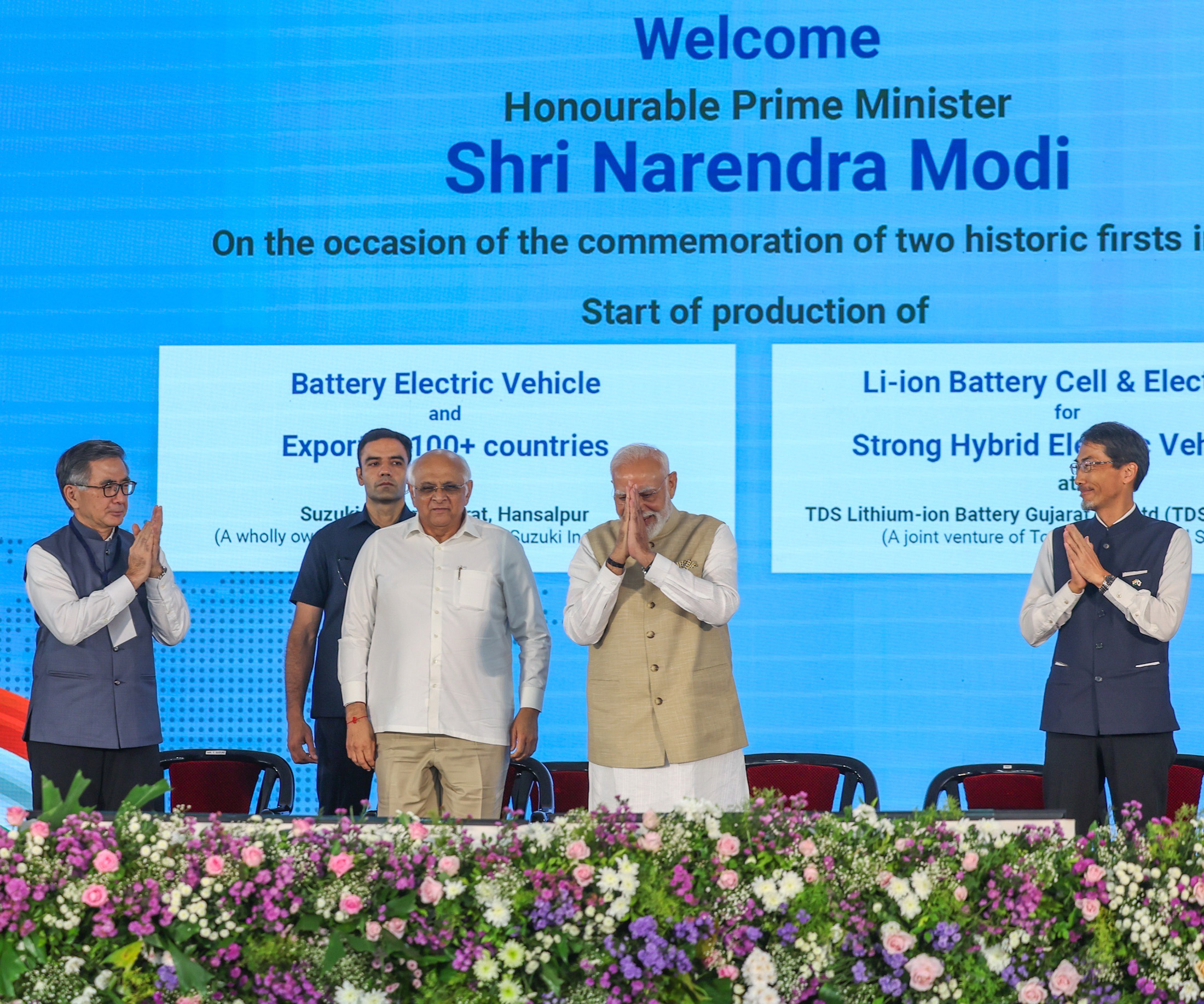
Suzuki began manufacturing lithium-ion battery cells in India alongside the EV rollout, with electrode-level localisation at a joint venture with Toshiba and Denso. These batteries, which are critical for hybrid vehicles, will now be sourced and manufactured primarily locally, with only raw materials and semiconductors imported.
Suzuki referred to this step as a “salute to Atmanirbhar Bharat,” India’s self-reliance initiative, and reaffirmed its commitment to a multi-powertrain strategy that includes EVs, strong hybrids, ethanol flex-fuel, and compressed biogas vehicles to achieve carbon neutrality.
Inauguration by Prime Minister Modi
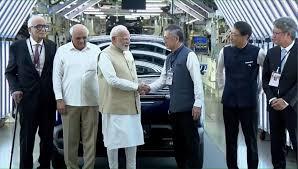
Prime Minister Narendra Modi inaugurated the production line and launched the first EV exports, describing it as a “major leap” for India’s Make in India initiative. “Every product made on Indian soil, regardless of origin, represents our strength,” Modi said during the event.
The launch coincided with Ganesh Chaturthi, which Modi and Suzuki executives said represented a new chapter in India’s mobility evolution.
Market Impact and Expansion Plans
Maruti Suzuki shares rose 2.6% to a record high following the announcement. The company, which accounts for roughly 40% of India’s car market, intends to nearly double its production capacity to four million vehicles by 2030, with new plants in Haryana and Gujarat.
The Hansalpur-Becharaji facility in Gujarat, which is central to Suzuki’s EV strategy, will eventually be expanded to produce one million units per year, making it one of the world’s largest automotive hubs.
Competitive Landscape
Although electric vehicles account for only about 4.5% of total car sales in India this year, the segment is rapidly expanding, with the government aiming for 30% penetration by 2030. Tata Motors remains the market leader, with Hyundai and Mahindra expanding their electric offerings.
Suzuki, which had previously scaled back its EV plans in India, sees the launch of the e-Vitara as a strategic reset, with India becoming not only its largest market but also a critical launchpad for its global EV ambitions.