

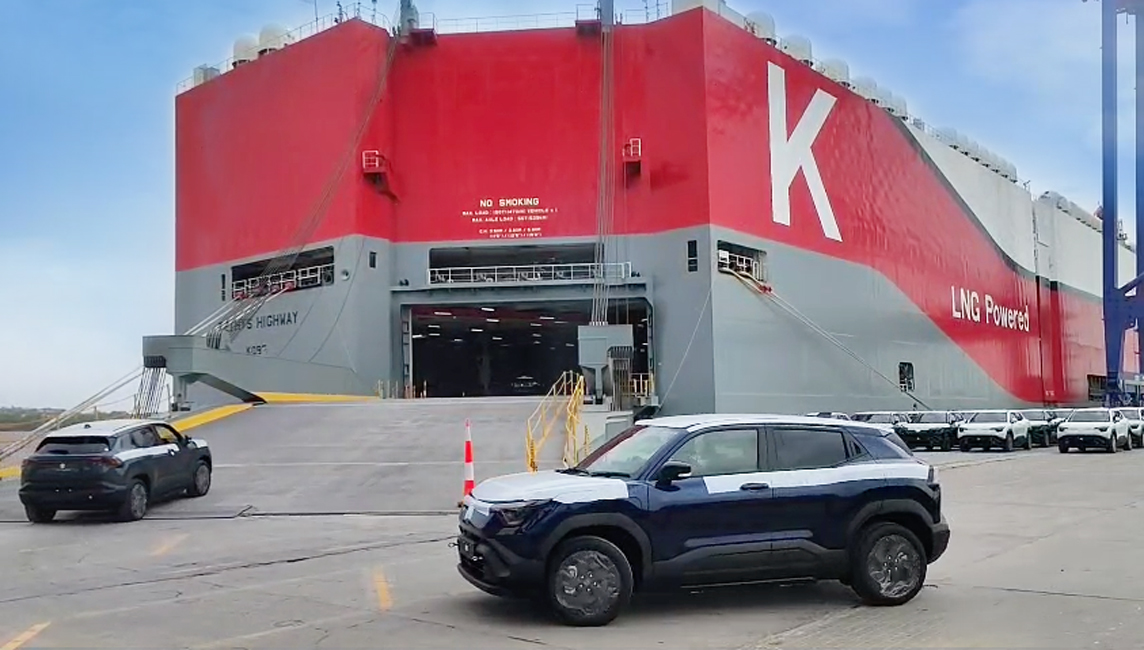
 NEW DELHI, 1st September 2025:Maruti Suzuki has launched exports of its first battery electric vehicle, the e-Vitara, shipping over 2,900 units in August from Pipavav Port in Gujarat to 12 European countries. This move highlights India’s growing role in the global electric vehicle (EV) manufacturing sector.
The e-Vitara is produced exclusively at Maruti Suzuki’s Hansalpur facility in Gujarat and is headed for markets including the U.K., Germany, Norway, France, and the Netherlands. The company plans to expand shipments to over 100 countries alongside the vehicle’s domestic launch later this year.
Recently, Prime Minister Narendra Modi inaugurated the Hansalpur production line, praising Maruti Suzuki as a “brand ambassador of Make in India.” This reflects the company’s strategy to manufacture locally while exporting globally.
Maruti Suzuki’s focus on exports comes at a time of weak domestic demand. In August, passenger vehicle sales were nearly flat at 180,683 units, down slightly from 181,782 units a year earlier, with domestic sales declining by 8% to 131,278 units. Demand for utility vehicles fell by 14%, decreasing from 62,684 to 54,043 units.
In contrast, exports surged by 40% to 36,538 units, underscoring Maruti’s increasing reliance on global markets to offset domestic challenges. The rollout of the e-Vitara in Europe signifies that exports are moving from an afterthought to a central pillar of Maruti’s operations.
India as a Global EV Manufacturing Hub

This initiative marks a significant shift as India evolves from primarily serving the domestic auto market to becoming a key player in global EV supply chains. Gujarat, with its advanced port infrastructure and pro-investment policies, is emerging as a strategic export gateway. The Hansalpur plant anchors this transition, supported by ports like Pipavav and Mundra, which have handled record volumes, enhancing India’s automotive export capabilities.
Industry data shows that Gujarat’s automotive manufacturing sector attracted investments nearing ₹30,000 crore in FY23, with exports valued at approximately ₹3,500 crore in 2024. Continued investments from Suzuki, including a recent ₹3,200 crore expansion of its EV production line, reinforce the state’s status as an automotive export powerhouse.
A Calculated Global Entry
Unlike early domestic EV leaders Tata Motors and Mahindra, Maruti Suzuki has taken a cautious, export-first approach. Hisashi Takeuchi, Maruti’s Managing Director and CEO, described the e-Vitara exports as a “proud and defining moment”, emphasising the vehicle’s world-class technology, design, safety, and performance built on the new HEARTECT-e platform.
Europe’s highly competitive EV market, dominated by brands like Volkswagen, Hyundai, and Tesla, serves as a rigorous testing ground. Success in this market could validate Maruti’s technical capabilities and open doors to broader international markets.
The Role of Gujarat
Gujarat’s rise as a global automotive hub is no coincidence. Its strategic location, robust infrastructure, and business-friendly policies attract significant investment. The state’s ports and industrial corridors, especially around Mehsana near Hansalpur, foster export growth and the development of a component ecosystem. The local government’s support, including commitments to cluster development and EV-friendly policies, further solidifies this positioning.
An Ahmedabad-based industry analyst commented, “Gujarat is no longer just a manufacturing base—it’s becoming the global launchpad for Suzuki’s electric ambitions.”
A New Era for India’s Auto Sector
Europe’s stringent emissions regulations and rapid EV adoption present opportunities but also require high standards. By targeting 12 diverse countries, ranging from established markets like Norway to developing ones like France, Maruti Suzuki is betting on a broad consumer base to support its global EV aspirations.
This approach aligns with government efforts to establish India not only as a substantial EV consumption market but also as a global manufacturing hub. Maruti Suzuki aims to replicate its historic role as a global small-car factory, transitioning that success into the electric vehicle sector.
The export-led growth model could stimulate India’s broader EV ecosystem, benefiting startups, suppliers, and technology firms in battery technology and components, thereby creating a ripple effect in employment and innovation.
With the e-Vitara, India is positioned at the heart of Suzuki’s global electrification journey. If embraced by discerning European consumers, Gujarat could witness a surge in EV production, catering to both domestic and international markets.
From Hansalpur’s modern assembly lines to showrooms in Berlin, Oslo, and beyond, the e-Vitara’s journey reflects India’s auto industry repositioning itself—from producing cars primarily for its own roads to becoming a vital player in the global automotive landscape.