

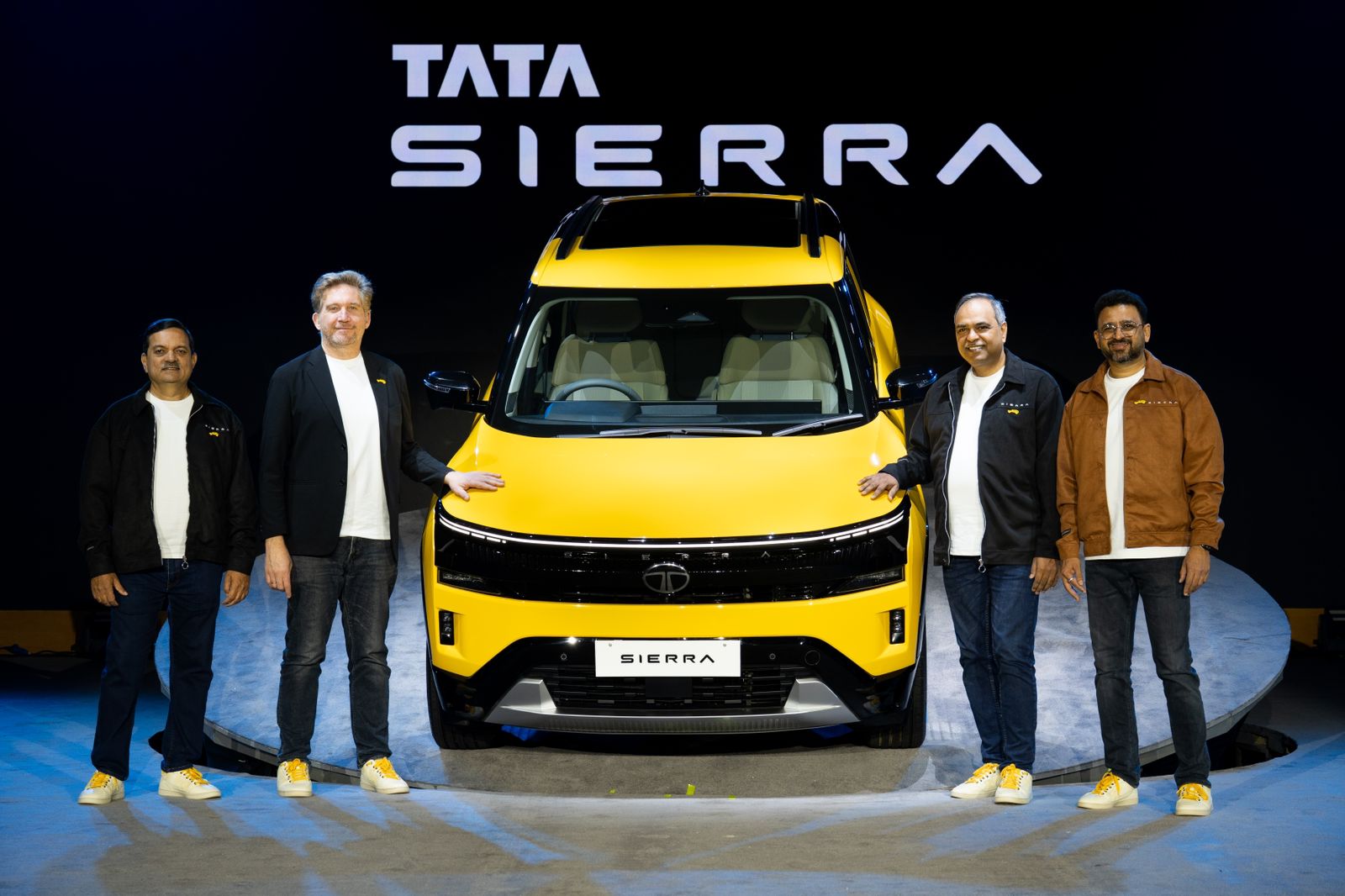
MUMBAI, 25th January 2025: The Tata Sierra, unveiled today at Rs 11.49 lakh, is back not as a nostalgia teaser or concept placeholder but as a fully engineered midsize SUV aimed squarely at Hyundai’s Creta.
With one strategic launch, Tata Motors has put the Sierra directly in the Creta’s line of fire, signalling its most determined attempt yet to loosen the Korean brand’s decade-long grip over the ₹11–20 lakh segment.
The Sierra is being positioned as far more than a nameplate revival. It is Tata’s first clean-sheet model, designed from the outset to support both combustion and electric powertrains, aligning the company with global SUV architecture trends and future-proofing the product for a market that is gradually tilting toward EVs. Against the Creta, which has defined the segment in terms of consistency, refinement, and breadth of variants, the Sierra arrives not as an incremental evolution but as a statement of intent.
Design, Experience and Space: Playing the Segment on Feel, Not Just Figures
Visually, the Sierra leans on its legacy without being trapped by it. The upright stance and modern reinterpretation of the iconic wraparound rear glass lend it instant recognition, while the boxier proportions give it a more authentic SUV form than the Creta’s sharper, split-lamp treatment. At 4.35 metres with a 2,730 mm wheelbase, the Sierra is marginally larger, and Tata is keen to convert those millimetres into something buyers can feel rather than just read on a spec sheet.
Inside, that translates into what Tata calls segment-best interior room. The company claims leading couple distance, shoulder width and second-row legroom, plus a 316 mm “gangway” at the rear that allows easier movement across the bench. Luggage space is rated at 622 litres, the largest in the class, giving the Sierra a practical edge for families that treat their SUV as a weekender and long-distance hauler rather than just an urban runabout.
Theatre, Tech and Comfort: Turning the Cabin into a “Life Space”
If the exterior plays on familiarity, the cabin is where Tata lets the Sierra break character. The headline act is the Horizon View triple-screen layout, including a dedicated 12-inch infotainment display for the co-passenger — a clear signal that the front seat is meant to be occupied, not just chauffeured. A Dolby Atmos-enabled, 12-speaker JBL Black audio setup paired with a SonicShaft soundbar and an Arcade Suite with 30+ apps for OTT streaming, browsing and gaming push the car deeper into the territory of a rolling living room than a traditional SUV.
Tata Motors has used ergonomics not as an afterthought. Individualised driver profiles, powered seat memory, a thigh-support extender and Tata’s new Superglide suspension with frequency-dependent damping are meant to dial fatigue out of the daily commute.
Overhead, a PanoraMax glass roof at 1,525 mm by 925 mm, the largest in the segment, amplifies the feeling of airiness. Tata is openly framing this interior as a counterpoint to the Creta’s more conventional, functionality-led cockpit, betting that comfort and ambience will be as decisive as power and price.
Performance, Hardware and the EV Gambit
Under the hood, Tata has mapped the Sierra’s engine-and-gearbox mix almost panel-for-panel against Hyundai’s playbook. The new 1.5-litre Hyperion Turbo GDi petrol makes 160 PS and 255 Nm, while a naturally aspirated 1.5-litre unit anchors the entry variants. Diesel duty—still a priority in northern and western markets and is handled by the 1.5-litre Kryojet CRAIL, rated at 118 PS and 280 Nm and pitched as best in segment for automatic torque.
Buyers get a six-speed manual and a seven-speed DCT, keeping the Sierra aligned with what Creta shoppers expect on paper.
Where Tata wants the Sierra to move from “just comparable” to “clearly ahead” is in its electric future. The EV sits on the new A.R.G.O.S. skateboard (All-Terrain Ready, Omni-Energy, Geometry Scalable), an architecture that is AWD-capable, 5G-ready and explicitly software-centric. Hyundai’s Creta EV may have drawn first blood, with more than 4,000 units sold since January, but demand has begun to cool. Tata is reading that plateau not as a warning but as an opening to land with a more rounded package.
On-board Tech and Safety: Pitching the “Smarter” Alternative
To underscore that future-facing pitch, the Sierra introduces the Snapdragon Auto 5G SA 522 chipset, billed as an automotive first to power faster OTA updates, richer in-car apps and more consistent connectivity. Real-time navigation with offline Mappls routing and a connected suite of 75 features under Tata’s iRA platform push the feature list well beyond basic telematics and remote lock-unlock tricks.
On the safety and assistance front, the Sierra rolls out L2+ ADAS with 22 functions and a HypAR head-up display projecting 19 live driving cues, from navigation to warnings. The intent is clear: to position Tata’s flagship as the more “tech-native” SUV in a segment where Hyundai has so far leaned on a more traditional, proven electronics package that gets the job done without drawing much attention to itself.
Branding, Lifestyle and the Halo Around the Sheet Metal
Unlike the Creta, which built its success on broad, almost appliance-like universal appeal, the Sierra is being engineered as a lifestyle-forward brand. Partnerships with Huemn, Delhi Watch Company, Nappa Dori and Starbucks are meant to pull it into conversations about culture and identity, not just kilowatts and boot space. Tata wants buyers to see the Sierra less as a rational upgrade and more as a badge around which they can build a personal narrative.
The exterior detailing leans into that positioning. Full-width LED light sabres with animated welcome sequences, Bi-LED booster headlights, floating centre console elements, new soft-touch interior textures and 19-inch alloy wheels – the largest in the segment – are all designed to give the Sierra a stronger “occasion” feel than the Creta’s more everyday-friendly aesthetic. In a market where many SUVs rarely leave the city, Tata is effectively selling attitude as much as all-terrain ability.
The Road Ahead: High Ambition, Tight Margin for Error
The real test, however, begins after the social-media buzz fades. Hyundai’s core advantage remains consistency: refined powertrains, a reliability perception built over a decade, and a service network that is both deep and predictable. For all its features and flair, the Sierra will ultimately be judged on how it holds up in early production, how smoothly its electronics behave in the real world, and how Tata’s service ecosystem absorbs an influx of more demanding, tech-savvy customers.
Even so, the Sierra feels like Tata’s most credible shot yet at the Creta crown, not because it tries to clone Hyundai’s formula, but because it challenges it on different axes. With standout space, segment-topping screens and comfort, competitive engines and a clear EV roadmap baked into its architecture, Tata has created a challenger that combines emotional pull with technical substance.
Bookings open on 10th December and deliveries commence from 15th January 2026. For the first time in years, the midsize SUV segment, long dominated by one name, has a contender that looks ready not just to participate but to genuinely disrupt.