

MUMBAI, 27th August: India’s banking industry is working on a pilot with the RBI to simplify the dissemination of credit, much like making payments using UPI or GPAY. Following the transformation of payments through UPI, India is now banking on the Unified Lending Interface (ULI) to revolutionize credit access.
This new platform aims to unlock loans and provide seamless financial services to small businesses, electric vehicle (EV) fleets, and gig workers who have long been excluded from the formal financial system.

At the FICCI-IBA Annual Banking Conference (FIBAC) in Mumbai, bankers and policymakers expressed a strong sense of urgency regarding the platform currently being developed by the Reserve Bank of India (RBI) through its innovation arm, the Reserve Bank Innovation Hub (RBIH). Rajneesh Karnatak, Managing Director of Bank of India, stated, “Just as UPI became the backbone for digital payments, ULI has the potential to become the backbone for digital lending.”

Ambition Meets Challenges
While the ambitions surrounding ULI are significant, the challenges are equally daunting. Unlike UPI, which facilitates instant transfers of existing funds, ULI requires a comprehensive assessment of credit risk. This entails that banks need to verify income streams, collateral, and repayment history before approving loans. The goal of ULI is to streamline and clarify this process, making it less fragmented and opaque.

By utilizing secure APIs, lenders can connect to various platforms, including DigiLocker, GSTN, and even state-level digitized land records. Over time, this could expand to incorporate insurance policies, pension records, and shareholdings, thereby creating a more comprehensive picture of each applicant’s financial profile. For borrowers, this could lead to dramatic improvements in the loan approval process, reducing the waiting period from weeks to mere hours.
Addressing India’s $530 Billion MSME Credit Gap
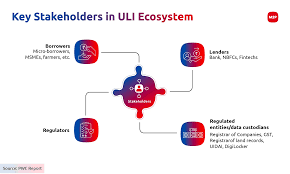
The greatest beneficiaries of ULI are expected to be India’s small businesses. According to estimates from the International Finance Corporation (IFC), India’s Micro, Small, and Medium Enterprises (MSMEs) face a staggering credit gap of $530 billion. Currently, only about 14% of MSMEs have access to formal credit, leaving the majority reliant on informal lenders that charge exorbitant interest rates.
With ULI, a small manufacturer could authorize the extraction of their GST returns, invoices, and bank statements to create a single loan application, thereby eliminating extensive paperwork. A senior public sector banker at FIBAC remarked, “This will democratize credit for small businesses that have historically been locked out.”
Facilitating Finance for EV Fleets and the Gig Economy
The impact of ULI could also extend to India’s shift towards electric mobility. EV fleet operators, including those in last-mile delivery and ride-hailing services, often struggle to secure financing due to lenders’ limited visibility into their revenue streams and asset values. Companies involved in battery leasing and small fleet management frequently exist in a grey area between MSME and consumer finance.
ULI has the potential to change this by integrating payment data from ride-hailing apps, telematics from fleet management systems, and GST filings from operators. For example, a food delivery rider using an e-bike could leverage their digital work history to obtain a small loan, something that currently requires them to pledge collateral that they may not possess.
As an executive from a private sector non-banking financial company (NBFC) stated, “The EV ecosystem is capital-hungry and highly data-rich. If ULI can channel that data into credit decisions, it can be transformative.”
Establishing a Digital Framework for Credit
For banks and NBFCs, ULI represents a plug-and-play architecture that can reduce customer acquisition and underwriting costs. A BCG partner mentioned during a panel discussion, “What UPI did for digital merchants, ULI can do for lenders.”

By integrating tax, payment, and employment records, the platform could facilitate a range of financial products, from unsecured working capital loans to vehicle financing. In certain states, digitized land records are already being connected, which may help streamline agricultural and rural lending.
However, bankers cautioned that having the infrastructure alone won’t ensure success. Data quality, privacy protections, and a robust consent framework will be crucial for user adoption. Furthermore, processes for fraud detection and grievance redressal must be integrated from the outset to prevent misuse.
Risks and Preparedness
India’s experience with UPI indicates that, if trust is established, rapid scale can be achieved. Yet, the complexities of ULI suggest that its rollout may be gradual. Unlike payment transactions, which merely inconvenience users when they fail, a poorly underwritten loan can pose systemic risks.
There are also concerns about whether smaller lenders will be able to integrate into the platform effectively, or if ULI will initially favor larger, tech-savvy banks. A former regulator warned, “The challenge is not just technological, but institutional—we need common standards across lenders.”
The Stakes Ahead
Nevertheless, the potential rewards of ULI are immense. By bringing millions of underserved borrowers into the financial system, ULI could accelerate credit availability, support economic growth, and enhance financial inclusion. Analysts assert that India’s future growth hinges not only on infrastructure investment and consumer spending but also on the capacity of small enterprises and workers to access timely, affordable financing.
The Reserve Bank of India (RBI), in collaboration with the Reserve Bank Innovation Hub (RBIH), has launched the Unified Lending Interface (ULI) — a pioneering digital public infrastructure set to transform India’s lending landscape.
Building on the remarkable success of the Unified Payments Interface (UPI), ULI is designed to streamline credit delivery, enhance transparency, and democratize loan access, particularly for underserved segments such as micro, small, and medium enterprises (MSMEs), rural borrowers, tenant farmers, and gig economy workers.
Bridging the Credit Divide
India’s 63 million MSMEs, which serve as the backbone of the economy, have long faced difficulties in securing timely and affordable credit. Despite their contribution to employment and GDP, only 14–16% currently have access to formal financing. This leaves a credit gap of nearly $530 billion, according to industry estimates.
Ruchin Goyal, Managing Director and Senior Partner at BCG, says ‘‘India’s banks have delivered strong performance in recent years, but to truly power the Viksit Bharat mission they must grow 3–3.5 percentage points faster than nominal GDP. The sector has a unique opportunity to unlock the next wave of growth by leveraging alternate data and DPI 2.0 to bring millions of new-to-credit households and MSMEs into the formal lending system. At the same time, banks must move beyond incremental productivity gains and use GenAI for a step-change—rewiring core processes, redeploying capacity to higher-value activities, and setting new global benchmarks for efficiency. If they act decisively, banks won’t just support the mission—they’ll become the very engine of Viksit Bharat.”
ULI’s goals and functions
ULI aims to address this structural challenge by creating a seamless, interoperable digital lending ecosystem. Built on open APIs and a consent-based framework, ULI enables borrowers to access a broad network of lenders through a single, unified platform, akin to how UPI disrupted payments.
ULI has the potential to create a UPI-like explosion in lending. Regulators, the Government, and the Financial Services sector all will need to work together to build access and digital registries to enable this (e.g., digital land records).
Mr C S Setty, Chairman of Indian Banks’ Association, said, “India’s Digital Public Infrastructure has revolutionized access through Aadhaar, UPI, and Jan Dhan, and the next frontier lies in DPI 2.0 platforms like Account Aggregator and Unified Lending Interface (ULI). To unlock their full potential, banks must go beyond transactions and deliver seamless, end-to-end digital experiences to the customers that combine trust, simplicity, and omni-channel support leveraging GenAI as well. By doing so, banks can deepen inclusion, strengthen customer relationships, and create a truly world-class digital banking ecosystem.”
With ULI, the RBIH aims to make credit delivery more frictionless, inclusive, and efficient, empowering both borrowers and lenders through real-time data access, digital KYC integration, and alternative credit assessment tools. This initiative marks a pivotal step toward financial inclusion at scale, reinforcing the government’s broader vision of building a resilient, technology-driven financial ecosystem for a billion Indians.
Plug-and-Play Digital Architecture for Credit Distribution
ULI functions as a plug-and-play digital architecture, enabling frictionless communication between borrowers, lenders, fintechs, and data providers. By aggregating financial and non-financial data, such as GST filings, bank statements, digital payment records, utility bills, and more, ULI allows for data-driven underwriting, even for borrowers with limited or no credit history.
Lenders gain real-time access to verified data via a consent-layered system, dramatically reducing the time, cost, and complexity involved in loan origination and risk assessment. For MSMEs, especially in Tier II and Tier III regions, this means faster approvals, lower interest rates, and reduced dependence on collateral or conventional credit scores.
Expanding the Financial Inclusion Frontier
One of the standout features of ULI is its deep integration with government-backed digital infrastructure, including Aadhaar, DigiLocker, and GSTN. This integration enables instant e-KYC, documentation verification, and seamless onboarding, thereby minimising bottlenecks in traditional lending processes.
In rural and semi-urban areas, where informal borrowing is rampant, ULI provides a credible alternative by facilitating formal credit access based on alternative creditworthiness indicators, such as digital transaction behaviour, repayment patterns on utility bills, and agricultural produce records.
The platform also holds significant potential for agri-credit and gig workers. Tenant farmers, who often lack land records, and gig workers, who have sporadic income trails, can now leverage their digital footprints to secure loans through verified and structured digital profiles.
India’s ambitious push towards becoming a $5 trillion economy hinges heavily on the growth of its digital economy and inclusive financial systems. With the digital lending market projected to surpass $400 billion by FY29, ULI is expected to be a cornerstone in enabling that growth.
By aligning with the government’s broader vision of Digital Public Infrastructure (DPI), including initiatives like UPI, Account Aggregators, and the JAM trinity (Jan Dhan, Aadhaar, Mobile), ULI promises to create a cohesive, scalable, and resilient financial ecosystem.
Looking Ahead
As ULI rolls out nationwide, the coming months will be crucial for stakeholder alignment, infrastructure onboarding, and ecosystem readiness. For fintechs and lenders alike, it’s a once-in-a-decade opportunity to reimagine credit for a billion Indians.